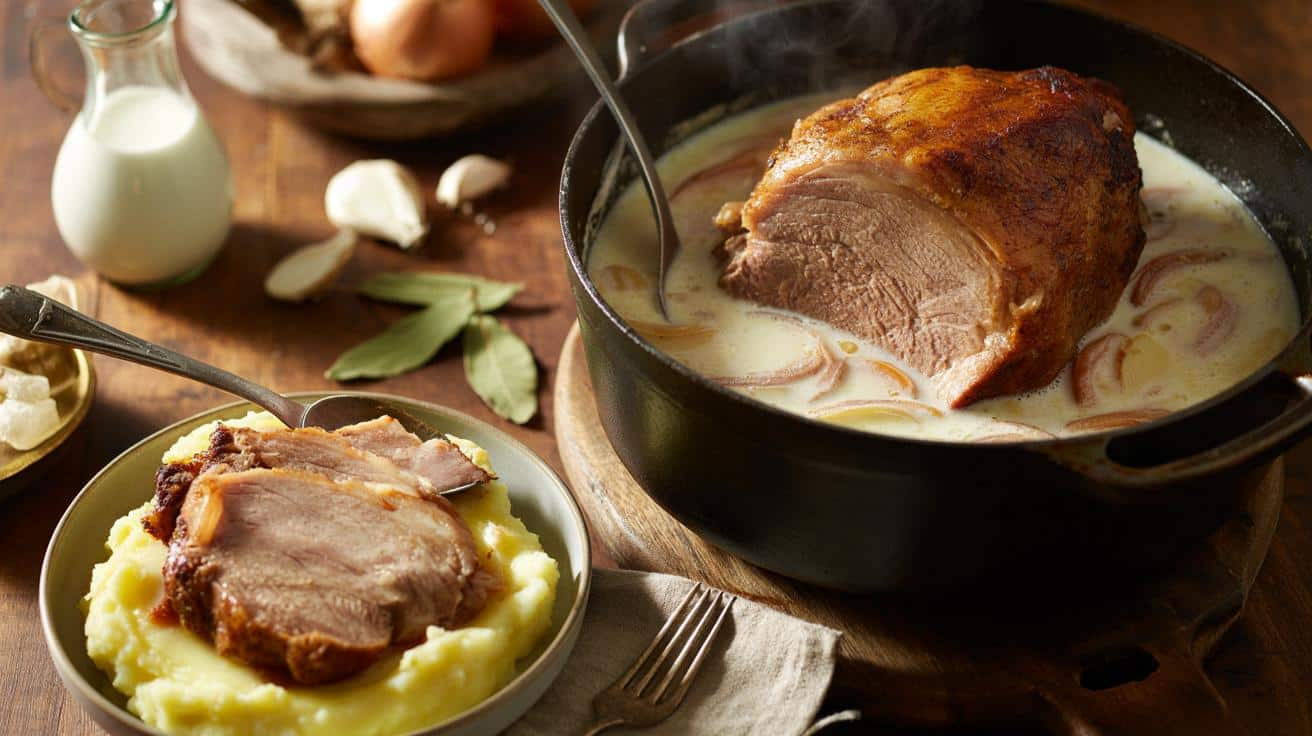
The recipe behind that scene is disarmingly simple: pork, milk, onions, garlic and time. Yet the result is a roast so soft it barely holds together, bathed in a rustic, creamy sauce that clings to mashed potatoes or fresh pasta. It feels like restaurant food, but it was really your oven doing the work while you got on with your day.
Why milk turns a plain pork roast into something extraordinary
Milk-braising sounds unusual if you grew up with gravies based on stock, wine or water. But cooks in parts of France and Italy have used this technique for generations, especially with pork.
The milk doesn’t just surround the meat, it slowly changes its texture, making each slice moist, mild and almost spoon-soft.
As the pork simmers gently, the milk heats, evaporates and thickens. The natural sugars in the milk help with caramelisation, while proteins interact with the juices from the meat. Garlic and onion fuse into that base, so by the end you get a sauce that’s creamy without needing cream, and deeply savoury without a single stock cube.
Towards the end of cooking the milk curdles and separates a little. That pan full of small, soft clumps can look alarming if you expect a perfectly smooth white sauce. Yet those curds are exactly what give this dish its rustic charm: they catch the fat, cling to the onions and form a nubbly, glossy coating for the meat and any side dishes.
Building a roast that almost falls apart
What makes this dish special is not a long list of ingredients, but the way they are used. The technique turns everyday staples into something that feels like a treat.
The cut of pork that gives you guaranteed tenderness
For a spoon-tender roast, the cut matters as much as the cooking method. Leaner cuts can dry quickly if overcooked; slightly fattier ones forgive you more.
- Pork shoulder (or Boston butt): well-marbled, great for long slow roasting.
- Pork neck or blade (similar to French “échine”): juicy, with enough fat to stay succulent.
- Pork loin or tender roast: leaner and neater in slices, but needs closer monitoring.
Home cooks who prefer structured slices might choose loin, but those who love that almost pulled-pork texture tend to favour shoulder or neck. The milk helps either way, yet the fattier cuts simply give you a larger safety margin and more flavour.
Layering flavour before the oven even starts
One reason this roast tastes as if it took professional effort is the way flavour is built in simple stages.
➡️ Italians Can’t Believe It: In France, Almost Everyone Cooks Pasta The Wrong Way
➡️ Grim photo captures polar bear mom and cubs resting in mud in summer heat
➡️ Italian torta nua: the recipe for this cloud cake with custard, a pure delight to share
➡️ What are the unexpected health benefits of walnuts?
Small steps—stuffing the meat with garlic, browning it briefly, and resting it on a bed of onions—turn basic pork into something rich and aromatic.
Cooked this way, the onion slices at the bottom of the dish act as both flavour and insurance. They keep the meat from sticking to the base while releasing sweetness into the milk. Garlic cloves, pushed into small cuts all over the roast, infuse the centre instead of just perfuming the outside.
A quick sear in a hot pan gives colour and adds roasted notes that milk alone cannot provide. That browned surface later melds with the sauce, giving you complex savouriness from minimal effort.
How slow heat and milk create that “cut-with-a-spoon” texture
The magic point with this dish is the long, controlled oven time. The first part of the cooking is covered: foil traps steam, keeps temperatures stable and prevents the top of the meat from drying out too fast.
As the roast simmers, collagen in the connective tissue starts to break down, turning into gelatin. That process takes time, not high heat. Gelatin then mixes with the milk and meat juices, coating fibres and keeping everything soft and moist.
Give the roast time and patience, and the fibres loosen so much that a spoon, not a knife, becomes a real option.
Removing the foil partway through shifts the dish into its second phase. Now the surface browns gently, and the milk reduces and curdles into that dense, spoonable sauce. The oven temperature can be lowered for the final stretch if you want the meat even more yielding, bordering on shreddable.
What to serve with milk-braised pork
This style of sauce loves simple, absorbent accompaniments. You want something that soaks up every last streak on the plate.
| Side | Why it works |
|---|---|
| Mashed potatoes | Soft and neutral, they drink in the sauce and highlight its creaminess. |
| Plain white rice | Light, comforting base that balances the richness of the pork. |
| Fresh pasta (tagliatelle, pappardelle) | Wide ribbons carry the thickened milk and onion mixture beautifully. |
| Roasted root vegetables | Carrots, parsnips or squash bring sweetness and a bit of chew against the tender meat. |
| Crisp green salad | Acidic dressing cuts through the roundness of the sauce and refreshes the palate. |
For a weeknight, rice and a handful of roasted carrots can be enough. For a Sunday table, mashed potatoes, roasted seasonal veg and a big salad turn the dish into a centrepiece that feeds a crowd without stressing the cook.
Can you make it ahead, and what about leftovers?
Milk-braised pork is surprisingly flexible. Because the meat is cooked in so much liquid, it reheats well and can be prepared in advance.
This is one of those dishes that quietly improves after a night in the fridge, as the flavours mingle in the cooled sauce.
Once cooled, the pork and sauce can be kept in the fridge for roughly two days. The fat will solidify on top, which you can either remove for a lighter result or stir back in when reheating for extra richness. A gentle reheat in a low oven or on the hob with a splash of extra milk loosens the sauce again.
Leftovers turn into quick meals: pulled into shreds and folded into soft rolls, spooned over buttered toast, or mixed with pasta and peas for an easy second-day dinner.
Why the milk curdles – and why that’s actually good news
For many home cooks, curdling is usually a sign that something has gone wrong. With this dish, it’s almost a badge of success.
Under heat, the proteins in milk tighten and separate from the liquid, especially when combined with acid or meat juices. That’s what forms those little soft grains. Instead of aiming for a smooth béchamel-style texture, this recipe embraces the separation and uses it.
If you prefer a more uniform sauce, there are two easy options. You can whisk the pan juices briskly for a few seconds to break up the curds, or blend the sauce with a hand mixer before serving. The flavour stays the same; only the look and texture change.
Practical tips, small adjustments and potential pitfalls
Several small decisions can tweak the outcome without complicating your life.
- Use whole milk: semi-skimmed works, but whole milk gives more body and flavour.
- Season the meat properly: under-seasoned pork will taste flat, as the sauce carries that same level of salt.
- Don’t drown the roast: the milk should come roughly halfway up the meat, not cover it entirely.
- Give it a rest: those 5–10 minutes out of the oven allow juices to redistribute instead of spilling out at the first cut.
One risk with milk-based dishes is scorching. A deep, oven-safe dish and a bed of onions reduce that risk significantly. Avoid extremely high temperatures and resist the urge to crank the oven just to speed things up; tenderness relies on time, not aggression.
From rustic tradition to modern comfort food
Milk-braised pork sits at an interesting crossroads between old-fashioned farmhouse cooking and the kind of honest comfort food people crave now. It uses cheap, familiar ingredients, generates its own sauce and doesn’t require specialist kit.
The method also travels well across cuisines. You can add lemon zest and sage for an Italian accent, swap in bay and nutmeg for a more classic French feel, or tuck in star anise and a touch of soy for a gently spiced twist. Each version still rests on the same principle: slow heat, protective milk and a cut of pork that likes a long, gentle bath.
For anyone who has ever sliced into a dry, disappointing roast, this approach offers a kind of quiet reassurance. You set it up, slide it into the oven, and let chemistry and time do their work. When the dish emerges and a spoon glides through the meat, the technique tends to earn a permanent place in the household repertoire.