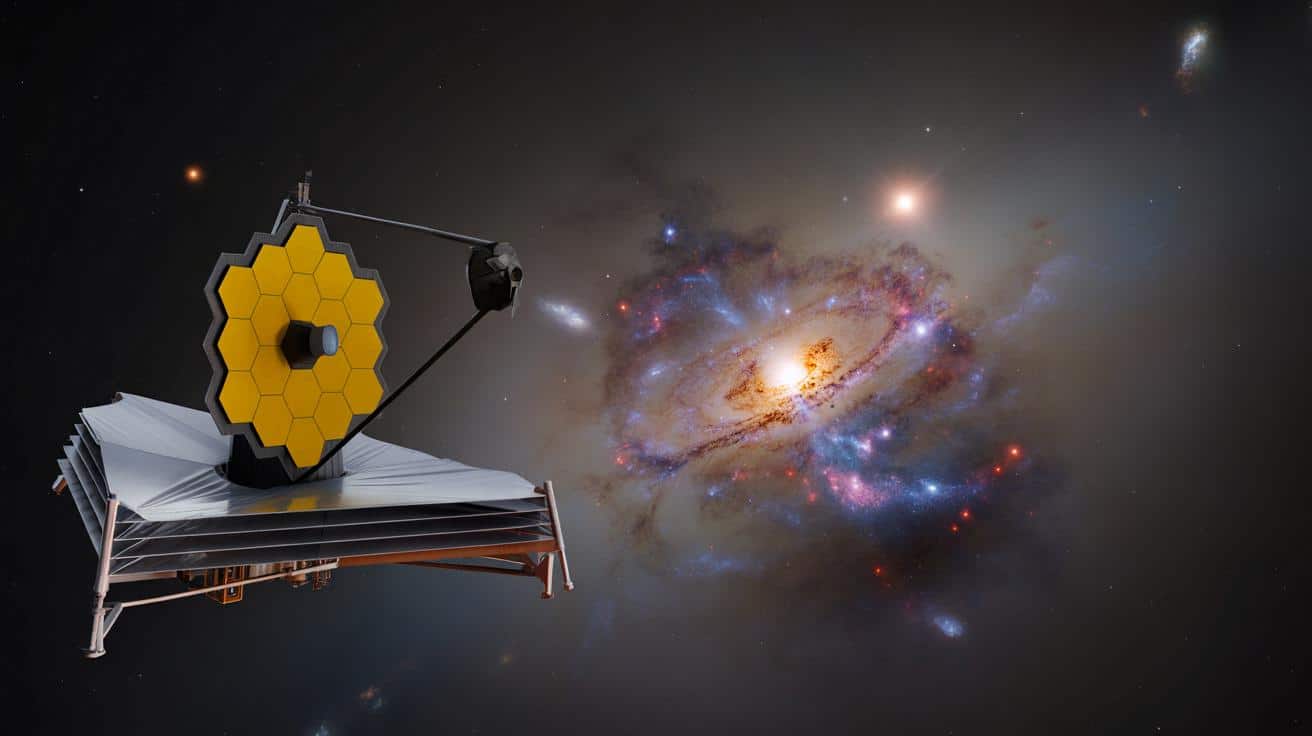
This new cosmic snapshot, captured by the James Webb Space Telescope (JWST), pushes observations deeper into time than any confirmed galaxy before, edging science closer to the era when the very first generations of stars ignited.
A record-breaking glimpse towards the Big Bang
Astronomers using JWST have identified a galaxy named MoM-z14 that sits closer in time to the Big Bang than any previously confirmed system. The light we see from it left the galaxy just 280 million years after the universe began — around 13.5 billion years ago.
MoM-z14 is now the earliest and most distant spectroscopically confirmed galaxy, pinned down only 280 million years after the Big Bang.
The team behind the work, led from the Massachusetts Institute of Technology (MIT), used JWST’s sensitive infrared instruments to measure MoM-z14’s “redshift”, a key indicator of distance in an expanding universe. They found a value of 14.44, just beating the previous record-holder, another JWST target named JADES-GS-z14-0.
Redshift works a bit like a cosmic speedometer and ruler combined. As space itself stretches, light from distant galaxies is stretched to longer, redder wavelengths. The higher the redshift number, the farther away — and the further back in time — astronomers are looking.
How JWST pushed the cosmic frontier
Since starting full operations in 2022, JWST has repeatedly upended expectations about the early universe. Astronomers expected to see a sparse, tentative cosmos during the first few hundred million years. Instead, Webb keeps turning up surprisingly bright, compact galaxies that seem to have formed stars rapidly and early.
MoM-z14 emerged from a careful search of existing JWST images for promising early candidates. Once astronomers flagged it as a strong possibility, they pointed JWST back at the same patch of sky in April 2025 to obtain detailed spectra — the spread of light into its component wavelengths.
Those spectra hold two crucial pieces of information: distance and composition. For MoM-z14, the spectra clinched the extreme redshift and revealed chemical fingerprints that help describe how this early galaxy lived and evolved.
A tiny galaxy burning bright
MoM-z14 is small by modern standards. The team estimates its size at roughly 240 light-years across. That makes it about 400 times smaller than the Milky Way, which spans more than 100,000 light-years.
➡️ Italians Can’t Believe It: In France, Almost Everyone Cooks Pasta The Wrong Way
➡️ Grim photo captures polar bear mom and cubs resting in mud in summer heat
➡️ AIChina, Russia condemn Trump’s pressure on Venezuela
➡️ This melting parsnip–potato gratin even reconciles kids with winter vegetables
➡️ What are the unexpected health benefits of walnuts?
➡️ Shoppers in China rush to Ikea after furniture giant announces closure of 7 stores from Feb 2
In terms of mass, MoM-z14 is comparable to the Small Magellanic Cloud, a dwarf galaxy orbiting the Milky Way that is visible from the Southern Hemisphere. Yet for its modest size, MoM-z14 shines intensely in JWST’s images.
The galaxy appears to be caught in a burst of rapid star formation, pouring energy into a compact region of space.
The spectra also hint at a curious chemical signature: MoM-z14 seems rich in nitrogen compared with carbon. That pattern resembles what astronomers see in some globular clusters — ancient, tightly packed groups of stars within the Milky Way.
What this tells us about the first generations of stars
Globular clusters are thought to be among the oldest structures in our galaxy, with ages stretching back more than 12 billion years. Their unusual chemical ratios have long puzzled researchers, and they may preserve traces of the conditions under which the earliest stars formed.
The similarity between MoM-z14 and those old clusters suggests that certain processes in star formation were already in full swing just a few hundred million years after the Big Bang. That implies the young universe may have become complex faster than many models suggested.
- MoM-z14 formed around 280 million years after the Big Bang.
- It is roughly 240 light-years wide, far smaller than the Milky Way.
- Its redshift, 14.44, makes it the current record-holder for distance.
- It shows signs of intense, ongoing star formation.
- Its chemistry resembles ancient star clusters in our own galaxy.
Rewriting theories of early galaxy growth
Before JWST, many simulations predicted that the first galaxies would grow slowly and remain faint for a long time. Early data from Webb, including MoM-z14, indicates that some galaxies became bright and massive relatively quickly.
This raises fresh questions about how rapidly gas cooled and collapsed after the Big Bang, how efficiently it formed stars, and how the first black holes might have grown inside young galaxies. If systems like MoM-z14 were common, they could have played a major role in “reionising” the universe — the process that made space transparent to light after an initial dark phase.
How astronomers measure such extreme distances
For very distant galaxies, astronomers rely on two main approaches: photometric and spectroscopic redshifts. Photometric estimates use the colours of a galaxy across different filters to guess its distance. Spectroscopic measurements, like those for MoM-z14, use sharp features in the spectrum, such as hydrogen emission lines, to pin the redshift down more precisely.
| Method | Strength | Limitation |
|---|---|---|
| Photometric redshift | Quick, works for large samples | Less precise, more prone to confusion |
| Spectroscopic redshift | High accuracy, robust confirmation | Needs more observing time, higher signal |
MoM-z14’s status as the closest known galaxy to the Big Bang comes from that more secure, spectroscopic measurement. Many other candidates with similar or even higher estimated redshifts are waiting in line for the same treatment.
What comes next: JWST and the Roman telescope
While JWST keeps breaking its own distance records, astronomers are already preparing for a new observatory: NASA’s Nancy Grace Roman Space Telescope, planned for launch as early as late 2026.
Roman will also operate in infrared, but with a much wider field of view than JWST. That means it will be able to map huge areas of sky and pick out many more distant candidates. JWST can then zoom in for the detailed, spectroscopic follow-up that nailed MoM-z14’s record-breaking status.
Together, Roman and JWST are expected to turn rare finds like MoM-z14 into full catalogues of early galaxies.
Researchers anticipate that the combined data will let them trace how galaxies grew from tiny, compact knots into vast systems like the Milky Way, and how early stars changed the chemistry of the universe over billions of years.
Key terms that help make sense of MoM-z14
For readers following these announcements, a few concepts appear again and again:
Redshift: A measure of how much light has been stretched by the expansion of the universe. Higher redshift means the object is both farther away and seen at an earlier time.
Light-year: The distance light travels in one year, around 9.46 trillion kilometres (or about 5.88 trillion miles). When astronomers say a galaxy is 13 billion light-years away, they are also saying its light has taken 13 billion years to reach us.
Star formation rate: How quickly a galaxy is turning gas into stars. Galaxies like MoM-z14 appear to be racing through their gas, creating large numbers of new stars in a short period.
Why early galaxies matter for everyday astronomy
Finding systems like MoM-z14 affects more than just high-level cosmology. Models used to interpret nearby galaxies, star clusters and even planetary systems rely on a solid understanding of when and how the first stars formed. If early galaxies turn out to be more common or more efficient at making stars than predicted, many of those models need adjustment.
There are also knock-on effects for the chemical elements that make planets and, ultimately, life. The first stars forged the universe’s heavier elements — carbon, nitrogen, oxygen, iron and so on — through nuclear fusion and supernova explosions. Early, vigorous star formation means those elements might have spread through space earlier than many astronomers assumed, potentially shaping when rocky planets could form.
As JWST continues to scan the sky, MoM-z14 may soon be joined by even earlier galaxies. Each new measurement will sharpen the timeline from the Big Bang to the first stars, and gradually turn a once speculative era of cosmic history into something that can be studied in detail, galaxy by galaxy.