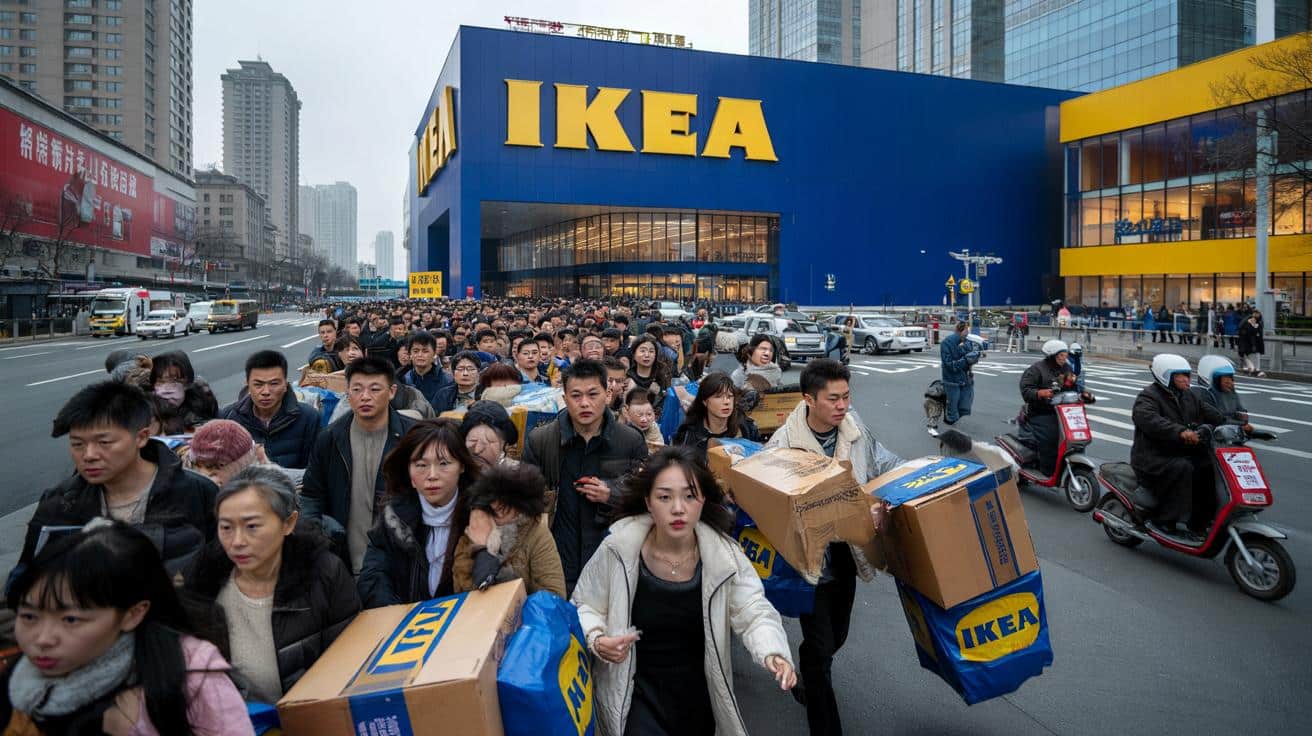
On a gray weekday morning in Shanghai, the blue-and-yellow box on the edge of the ring road looks like it’s hosting a festival. Taxis line up, horns twitching. Delivery riders lean on their scooters, scrolling their phones. Families push past the revolving doors with that fixed, purposeful look you usually see at train stations before Lunar New Year.
Word has spread fast: Ikea is closing seven stores in China from February 2.
Inside, the familiar maze feels charged. Shoppers stroke sofa arms, test mattress springs, snap photos of tags as if they’re documenting an endangered species. A young couple argues softly over a TV unit. An older man walks slowly through the kitchen section, touching each cabinet handle like a farewell tour.
The meatball line is the longest anyone can remember.
Nobody wants to miss what might be their last cheap coffee under that fluorescent, very Swedish sky.
The last-chance rush through the blue-and-yellow maze
As soon as the closure date leaked onto Chinese social media, the atmosphere in many Ikea stores flipped overnight. What had been a casual weekend outing turned into something closer to a countdown. People weren’t just shopping. They were stockpiling memories.
By 10 a.m., the parking lots in cities like Shanghai, Shenzhen, and Guiyang were already near full. Staff wheeled out extra stock of **classic bestsellers**: the Billy bookcase, the Lack table, those storage boxes everyone swears by but never labels properly. In some aisles, you could barely push a trolley without nudging someone’s heels. The soundtrack of the day wasn’t the soft background music, but phone notifications, children whining, and the clack of price-tag scanners.
One 28-year-old office worker in Chengdu, Li Yan, said she called three friends as soon as she saw the news on Weibo. By lunch, they were all walking side by side through the showroom, phones out, sending photos to a group chat titled “Last Ikea run.” She piled her cart with duvet covers, candles, and a lamp she’d been eyeing for months.
At the checkout line, she laughed nervously. “I didn’t plan to spend this much. But when they’re closing, you just… panic a little,” she said, shifting a stack of plates.
We’ve all been there, that moment when a familiar place suddenly has an expiration date and you feel strangely compelled to own a piece of it. Even something as small as a 9.9 yuan mug starts to feel like proof you were there.
➡️ Kanzi the bonobo could play pretend — a trait thought unique to humans
➡️ Grim photo captures polar bear mom and cubs resting in mud in summer heat
➡️ AIChina, Russia condemn Trump’s pressure on Venezuela
➡️ This milk-braised pork roast is so tender you can cut it with a spoon
Behind the emotion, there’s a clear logic to this rush. Ikea has spent more than two decades turning its Chinese stores into weekend destinations, not just furniture warehouses. Cheap breakfasts, play areas, vast showrooms you could literally get lost in. The store closures snap that routine in half for entire neighborhoods.
People aren’t only reacting to discounts. They’re responding to a shift in their own city map. For many young Chinese, Ikea was their first encounter with a “dream apartment” aesthetic they could touch, test, and half-pretend to live in. *Losing the local store feels less like losing a retailer and more like losing a low-cost portal to a certain lifestyle.*
Let’s be honest: nobody really goes to Ikea just to buy “one thing and leave.” They go to wander, to imagine, to snack, to sit on a sofa they don’t own and talk about a future they’re not sure they can afford yet.
How shoppers are turning closure panic into smart opportunity
In the middle of the chaos, some shoppers have adopted a surprisingly calm tactic. They walk in with a real plan. Not a vague “let’s see what they have,” but a phone note titled something like “Ikea – last time.” They’ve listed the key rooms, measured their apartments, and screenshotted product codes from the website before heading out.
One woman I watched in Beijing kept flipping between her photo gallery and her Ikea app. She had drawn rough sketches of her living room and bedroom, with measurements scribbled along the edges. Her cart was full, yet each item had a purpose: a narrow shoe cabinet for a 70 cm hallway, a wall shelf exactly the width of her TV, a bunch of storage boxes to finally tame that corner behind the door. It looked less like impulse buying and more like a small-scale renovation.
Others admitted they were less prepared. A young guy in a black hoodie pushed a wobbling trolley stacked with random finds: a mirror, three cushions, a pot plant, and a bright green rug that didn’t match anything. He grinned when asked if he’d planned any of it. “I just thought, if I don’t grab it now, I’ll regret it,” he said.
That’s the emotional trap closures create: the fear of missing out beats rational planning. The risk is obvious. You go in thinking you’ll grab a discounted lamp. You leave with four boxes, no idea where they’ll fit, and a credit card bill that echoes for months. The staff see it every day and smile politely, but their eyes tell you they’ve done the same thing on their own breaks.
One floor manager in Wuhan summed it up between restocking shelves and directing traffic.
“People come in sad about the store closing,” she said, adjusting her badge. “But on the way out, most of them look oddly happy, like they salvaged something.”
To avoid getting swept up too far, several seasoned Ikea fans share a simple mental checklist with their friends:
- Walk the showroom once without a trolley. Just look and take photos.
- Sit down for a coffee or soft-serve. Recheck your budget while you rest.
- Only then pick up a yellow bag or trolley and head to the warehouse area.
- Buy duplicates only of things you use weekly: sheets, storage, basics.
- Double-check size labels against your home measurements before checkout.
It sounds basic, but in the surge of “last chance” energy, even level-headed people forget they live in small apartments with actual walls.
What these closures say about changing city life in China
Beyond the immediate shopping rush, the closure of seven Ikea stores lands in a very specific moment for China’s cities. Rents are shifting, e-commerce is entrenched, and more people are moving through flexible, sometimes precarious housing situations. A mega-store on the edge of town suddenly feels less convenient than a compact showroom downtown or a few taps on a phone.
Some of the crowds lining up at Ikea this week aren’t just mourning a brand. They’re dealing with a quiet anxiety about change. When big, solid things – malls, old markets, familiar chains – start disappearing or downsizing, daily life feels less anchored. Losing a local Ikea marks one more nudge toward a world where almost everything happens through a screen and a delivery app.
At the same time, the rush reminds us how physical spaces still pull people out of their apartments. Shoppers bumping trolleys, kids racing between displays, couples arguing softly about a sofa color; this is the kind of messy, real-world friction no app can recreate.
Ikea managed, for years, to be a shared cultural reference point in China: a place where students, grandparents, young parents, and solo renters all walked the same maze. Seeing seven of those mazes close at once presses a quiet question: where will that casual, low-cost “third space” energy go next?
The answer might be smaller city-center concepts, mixed-use community hubs, or something nobody’s named yet. For now, it lives in those overstuffed blue bags leaving the store, each one a tiny, portable fragment of a lifestyle that’s already shifting under people’s feet.
| Key point | Detail | Value for the reader |
|---|---|---|
| Last-chance crowds | Shoppers flock to closing Ikea stores to grab deals and preserve memories | Helps readers understand the emotional and practical reasons behind the rush |
| Smart shopping tactics | Using measurements, product codes, and a step-by-step visit strategy | Offers a concrete method to avoid panic spending during clearance periods |
| Deeper city shift | Store closures reflect changing retail habits and urban lifestyles in China | Gives context beyond the sale, linking one brand’s move to broader social change |
FAQ:
- Question 1Which Ikea stores in China are closing from February 2?Several large-format stores in secondary locations are slated to shut, mainly those with declining foot traffic or overlapping catchment areas. The exact list is being shared store by store via local announcements and Ikea’s Chinese website.
- Question 2Are there real discounts before the closures?Yes, most closing locations are offering varying markdowns, especially on bulky items and seasonal stock. Some iconic products sell out quickly, while everyday basics may see smaller price cuts spread over several weeks.
- Question 3Will online shopping and other Ikea stores continue as usual in China?Yes, Ikea isn’t leaving the country. The brand is shifting toward a mix of online channels, smaller urban formats, and remaining big-box stores in key cities, while rethinking locations that no longer fit their strategy.
- Question 4How can I avoid overspending during a “last days” sale?Go in with a written list, hard budget, and measurements of your home. Walk the store once without a trolley, take photos, then sit down to sort what you truly need before committing to a full cart.
- Question 5Why do people feel so emotional about a furniture store closing?Because Ikea has acted as more than a retailer: it’s been a social space, a weekend ritual, and a stage for imagining future homes. When that space disappears, the loss feels personal, even if the brand itself survives online and in other locations.