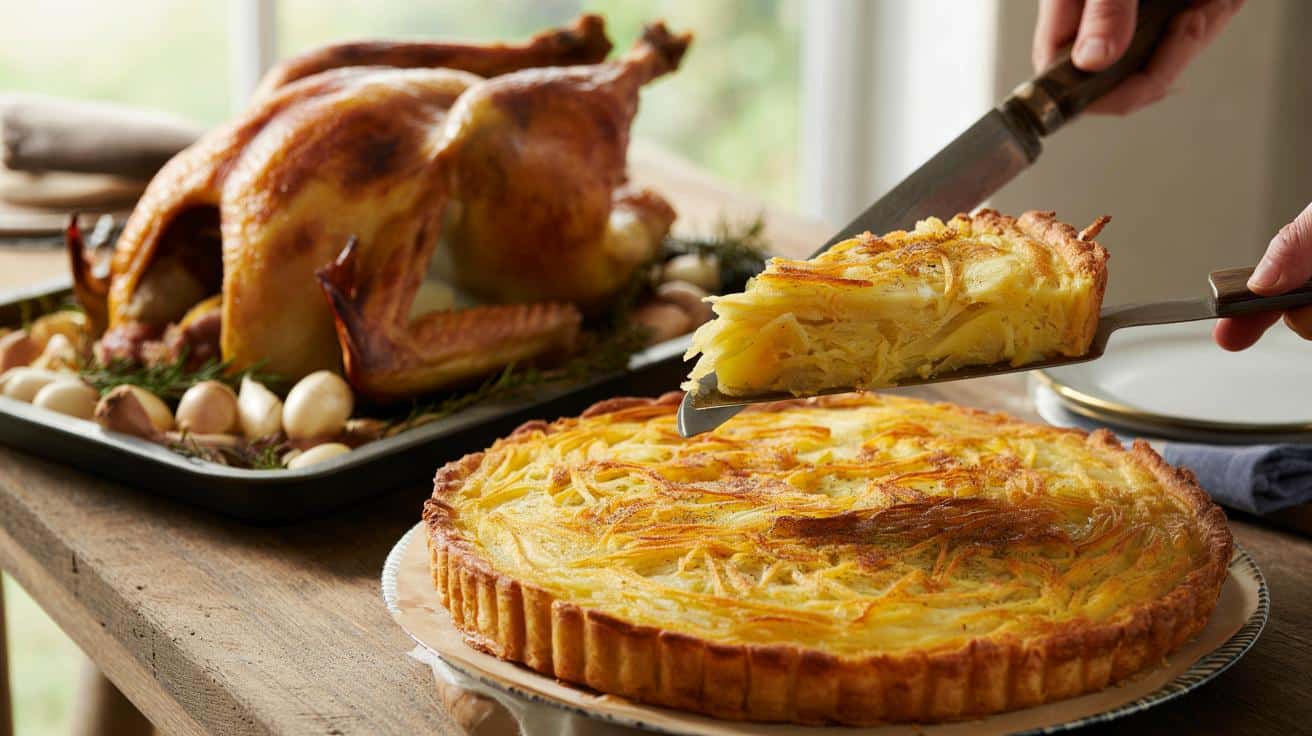
This time, French country cooking offers an alternative: a giant, crackling potato galette, baked flat like a tart, cut in generous wedges, and designed to soak up poultry juices without turning heavy.
A rustic potato galette that steals the show from gratin
In parts of rural Loire and Forez in central France, families once relied on a very simple Sunday dish: grated potatoes, a little onion, some flour, cheese and not much else. The technique, not the budget, did the heavy lifting.
The result is a thin, wide potato cake known as a “râpée paysanne” – literally a peasant-style grated galette. It emerges from the oven flat and golden, the edges crackling, the centre soft and tender.
This peasant galette behaves like a savoury tart: the knife snaps through the crust, the slices hold their shape, and the plate stays light.
Unlike a traditional gratin dauphinois loaded with cream and milk, this baked disc is mostly potato, bound with egg, a touch of flour and a generous layer of cheese. It sits somewhere between a rösti and a tray-bake tart, with the comfort of melted cheese but far less richness than a cream-based dish.
Set in the middle of the table, it invites sharing. Guests slice off wedges, reach back for more, and talk as they go. The atmosphere feels closer to a family farmhouse lunch than to a stiff, formal feast.
Why this potato galette flatters roast poultry
Picture a bronzed Christmas turkey, or a capon basted in butter, resting on its tray with cloves of soft garlic and sticky roasting juices. On the side, instead of yet another beige gratin, sits a large, evenly browned potato galette that almost crackles when the serving knife goes in.
The contrast does the magic. The galette brings crunch and structure, while the inside stays moist. It drinks in the roasting juices but resists collapsing into mush. Each forkful mixes the meat’s richness with the potato’s softness, the cheese’s depth and the savoury note of onion and garlic.
Where cream-based gratins can weigh a plate down, this grated potato cake sharpens flavours and keeps the mouthfeel brighter.
➡️ Italian torta nua: the recipe for this cloud cake with custard, a pure delight to share
➡️ Shoppers in China rush to Ikea after furniture giant announces closure of 7 stores from Feb 2
➡️ Kanzi the bonobo could play pretend — a trait thought unique to humans
➡️ Grim photo captures polar bear mom and cubs resting in mud in summer heat
It works particularly well with aromatic birds like guinea fowl, herb-roasted chicken or stuffed capon. The cheese and onion echo the roasted skin’s savoury notes, while the crisp surface gives a welcome break from soft textures such as stuffing and bread sauce.
The recipe also suits hosts juggling multiple dishes. It is economical, uses cupboard staples, and can bake on a tray beneath or beside the bird. No béchamel, no precise layering, no fragile timing. Once shaped and in the oven, it largely takes care of itself.
Key ingredients for the French-style potato galette
The original French version relies on very simple produce:
- Floury potatoes (such as Bintje, Marabel or russet-style varieties)
- Firm cheese that melts well (Comté, Gruyère, tomme or similar)
- One egg to bind the mixture
- A little wheat flour for structure
- One onion and a clove of garlic for flavour
- Freshly grated nutmeg, coarse salt and black pepper
- Neutral oil or melted butter for the baking tray
French cooks often grate the potatoes with the skin on, especially when they are organic. The peel contributes extra crunch and a faint nuttiness that pairs nicely with Alpine cheeses such as Comté or Beaufort.
Utensils you actually need
Part of the charm is how little equipment it requires. A home cook can manage it with just:
- A box grater with wide holes, or a hand-crank vegetable grater
- A large colander set over a bowl
- A big mixing bowl
- A large baking tray
- Non-stick baking parchment
- A spatula or a flat tray for turning the galette halfway
The critical step is not a special pan but the way the potatoes are pressed and spread: evenly, thinly and firmly, so the cake cooks through and goes crisp at the edges.
How the preparation works, step by step
Preparing and grating the vegetables
The oven needs to be properly hot – around 200°C, ideally on fan setting. Potatoes are scrubbed thoroughly and dried; if the skins are clean and thin, they stay on. They are grated on the coarse side of the grater straight into a colander resting over a bowl, followed by the onion and peeled garlic clove. The cheese is grated separately.
Pressing and using the potato starch
Hands do the next stage. The grated potatoes are squeezed hard inside the colander to remove as much liquid as possible. This step is what later gives the galette its snap and prevents sogginess.
The liquid that drips into the bowl looks cloudy. After a couple of minutes, clear water can be poured off from the top, leaving a thin white layer at the bottom: potato starch. Instead of discarding it, French cooks fold it back into the mixture. This natural starch helps bind the cake without resorting to extra flour.
Mixing the galette base
The squeezed potato is then combined with the reserved starch, onion, garlic and grated cheese. One egg goes in, along with flour, salt, pepper and nutmeg. The mixture is worked by hand until it forms a dense, slightly sticky mass.
The texture should feel like a rough, cohesive dough, not a loose batter. Density is what yields neat slices and crisp edges.
If the mix still seems overly wet, an extra spoonful of flour can be added, but restraint pays off. Too much flour will dull the potato flavour and toughen the bite.
Shaping and baking the large cake
A baking tray is lined with parchment and brushed lightly with oil or melted butter. The potato mixture is tipped on and spread evenly to roughly 1–1.5 cm thick, then pressed down with the back of a spoon or spatula so no gaps remain.
The galette bakes for about 40 minutes. Midway through, it is flipped carefully using a second sheet of parchment or a flat tray, then returned to the oven until both sides are evenly golden and firm to the touch.
Serving ideas that flatter festive birds
The galette is meant to be served piping hot. It can be cut into generous squares or wedges, then arranged close to the roast bird so that a little of the cooking juice runs underneath.
It pairs elegantly with capon stuffed with herbs, turkey with chestnuts, or guinea fowl roasted with thyme and lemon. Away from the holidays, it suits roast pork, grilled sausages, or even a plate of dressed salad leaves for a lighter supper.
Leftover slices reheat beautifully in a frying pan with a dash of oil, taking on new life as brunch beneath a fried egg.
Easy variations to adapt it to your kitchen
This humble base welcomes improvisation, which makes it friendly to British and American fridges alike.
- Swap French cheese for cheddar, Lancashire or a mild Swiss-style cheese
- Add crisped lardons, pancetta or streaky bacon for a smoky note
- Fold in chopped fresh herbs such as parsley, chives or thyme
- Scatter extra cheese over the top in the last minutes of baking for a thicker crust
The recipe also scales easily. A half batch suits a small household midweek, while a double tray can feed a long table of guests, provided the layers stay thin enough to crisp.
Understanding the technique: why it works so well
Two elements explain this galette’s success with roast poultry: starch management and water control. Grating exposes plenty of surface area, so potatoes brown more quickly. At the same time, firm pressing removes free water, which would otherwise steam the cake and soften the crust.
By re-using the natural potato starch at the bottom of the bowl, the cook gains binding power without added cream or heavy sauces. The egg and modest amount of flour then act as a discreet scaffolding, letting potato and cheese flavours stay at the front.
| Step | What it changes |
|---|---|
| Grating coarsely | Creates texture and more surface for browning |
| Pressing out liquid | Prevents sogginess and promotes crispness |
| Keeping starch | Helps the galette hold together when sliced |
| Thin, even layer | Ensures fast, even cooking and a firm base |
How this fits into a real-life holiday cooking plan
For home cooks planning a big festive meal, timing is often the stress point. This galette offers some flexibility. The mixture can be prepared an hour in advance and kept in the fridge; a light squeeze before baking will deal with any extra moisture. The cake can also be baked slightly ahead, then crisped up for a few minutes at a high temperature just before serving.
Another realistic scenario: one tray of galette under the roasting bird, catching some of the dripping fat and juices. This adds flavour to the potatoes while simplifying washing up. In that case, the tray may need rotating once to avoid any hot spots in the oven, but the method remains straightforward.
Beyond poultry: turning leftovers into new meals
For smaller households, leftovers can be a bonus rather than a burden. A chilled slice of potato galette reheated in a pan develops even more crunch. Topped with a poached or fried egg and served with a handful of bitter leaves such as rocket, it becomes an easy weekend lunch.
The same base can also be cut into small squares to serve as canapés with drinks, paired with sour cream, smoked trout or pickled onions. In that context, the dish shifts from supporting role to centre stage, showing how a once-forgotten country recipe can adapt to a modern, flexible table.