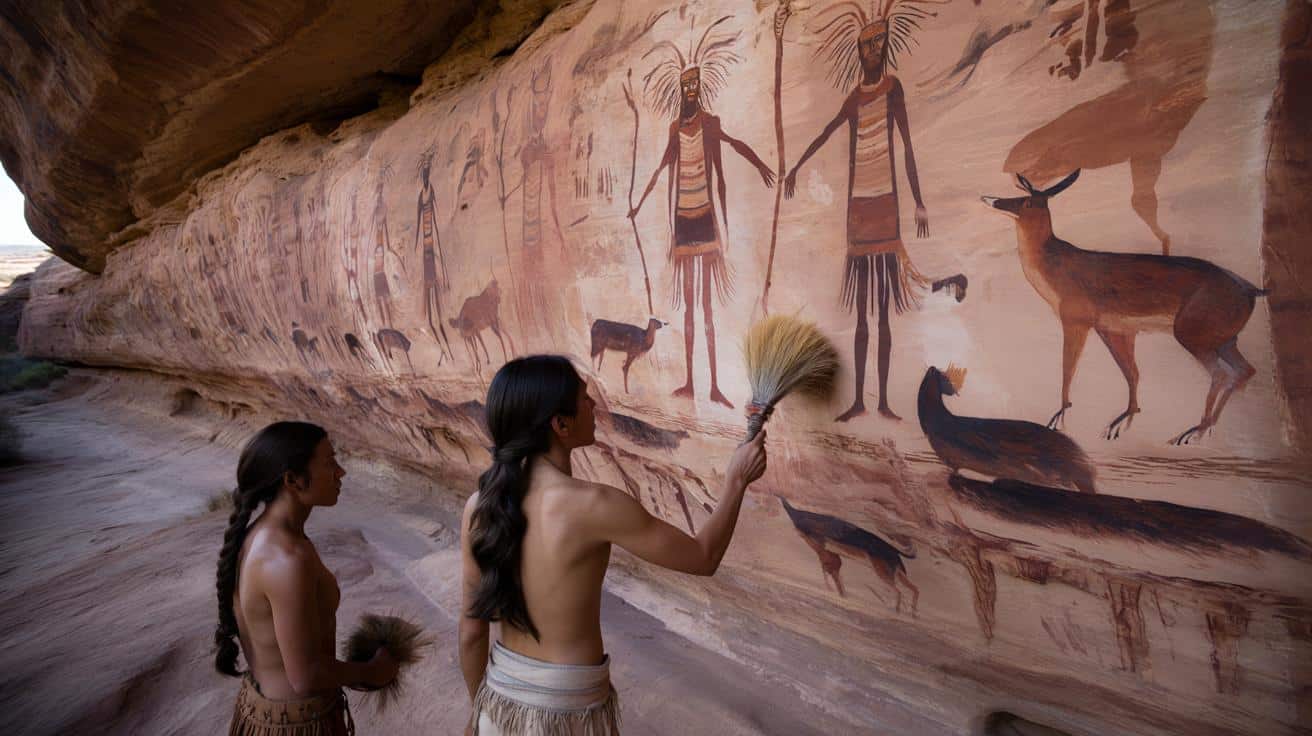
For thousands of years, small groups of hunter-gatherers along what is now the US-Mexico border returned to those cliffs, adding new figures and symbols to vast murals that mapped their understanding of the cosmos. A new study now shows that this rock art tradition endured for more than four millennia, preserving a remarkably stable Indigenous vision of the universe.
A 4,000-year record painted on stone
The new research focuses on the Pecos River style, a distinctive type of rock art spread across the Lower Pecos Canyonlands of southwestern Texas and northern Mexico. These arid canyons, carved where the Pecos River meets the Rio Grande, host hundreds of painted shelters and cliff faces.
Using advanced radiocarbon dating, scientists have shown that the tradition likely began nearly 6,000 years ago and continued until around 1,400 to 1,000 years ago. That stretch covers roughly 175 generations of artists painting in the same broad style.
The same visual language, repeated for millennia, suggests a powerful and long-lived religious system rooted in the landscape.
Despite climatic shifts, changes in hunting strategies and new stone and fibre technologies, the murals show tight continuity in technique and imagery across this enormous span of time.
Strict rules and a shared cosmic vision
Researchers examined more than a dozen mural sites in detail, looking not only at when they were painted, but how they were made. They found that the painters followed technical rules so consistently that they amount to a kind of visual grammar.
- Colors were applied in a recurring sequence.
- Human and animal figures followed familiar proportions and poses.
- Certain symbols appear in predictable positions within a mural.
- Compositions often unfold as narrative scenes rather than random clusters.
That kind of rule-bound repetition is unusual for foraging societies, which are often portrayed as flexible and loosely organized. Here, the art points to an enduring “cosmovision” — a complete framework for understanding the universe, including creation stories, the nature of time and the structure of the spirit world.
The murals function like illustrated manuscripts, encoding myths, rituals and a complex sense of time into colour and form.
Many scenes appear to recount origin myths, ritual performances and shamanic journeys. Figures hold staffs, darts and objects that may represent ritual paraphernalia. Other motifs hint at cyclical time and ceremonial calendars, such as repeating signs that may track seasons or celestial events.
➡️ AIChina, Russia condemn Trump’s pressure on Venezuela
➡️ This milk-braised pork roast is so tender you can cut it with a spoon
➡️ Grim photo captures polar bear mom and cubs resting in mud in summer heat
➡️ James Webb telescope discovers closest galaxy to the Big Bang ever seen
➡️ Kanzi the bonobo could play pretend — a trait thought unique to humans
➡️ Shoppers in China rush to Ikea after furniture giant announces closure of 7 stores from Feb 2
What the murals show: animals, spirits and specialists
Most Pecos River style panels are crowded scenes. Human-like figures stretch to imposing heights. Some are painted in red and black, with elaborate headgear or headdresses that could signal status or sacred roles.
Animals — deer, felines, birds and more abstract creatures — loom alongside them. In places, humans and animals merge into composite beings, a trait often tied to shamanic transformations in Indigenous traditions worldwide.
The scale can be staggering. Some murals extend more than 30 metres along a wall and rise over 6 metres high, with hundreds of individual images overlapping and interacting.
These are not casual doodles; they are monumental projects demanding planning, cooperation and shared ritual knowledge.
Archaeologists think ritual specialists, perhaps shamans or ceremonial leaders, helped design and direct these compositions. The art likely accompanied performance — chanting, dance, the burning of incense or resins, and perhaps the use of psychoactive plants that grow in the region.
Dating the undatable: new techniques on ancient paint
Dating rock art is notoriously tricky, especially paintings, which often lack clear layers of associated material. For this project, scientists combined two independent radiocarbon techniques on pigments from 12 mural sites, aiming for cross-checked accuracy.
| Step | What researchers did | Why it matters |
|---|---|---|
| Pigment sampling | Took microscopic samples of paint, often containing charcoal | Charcoal provides carbon needed for radiocarbon dating |
| Method 1 | Traditional radiocarbon dating of organic material in the paint | Gives an age range for the pigment itself |
| Method 2 | Additional radiocarbon technique for comparison | Checks for consistency and rules out contamination |
| Stylistic study | Analyzed themes, figure layout and color sequences | Linked scientific dates to broader patterns in the art |
The two dating methods delivered overlapping results, strengthening confidence that the murals span thousands of years rather than a short, intense burst of activity.
Who were the artists behind the Pecos River style?
The people who painted the Pecos River murals were mobile hunter-gatherers, not settled farmers. They moved through arid canyons and uplands in search of game, wild plants and water, long before large cities arose elsewhere in Mesoamerica.
No single named group can be securely linked to them, and direct ethnic continuity is hard to trace after so long. Yet their work shows intellectual depth that clashes with outdated stereotypes of foragers as simple or disorganized.
The painters worked with a robust symbolic system, using recurring signs to express a nuanced cosmology and social order.
Over thousands of years, different bands and communities must have visited the same shelters. Each generation likely learned the rules of painting from elders, adding new layers to old stories while maintaining the basic structure of the cosmovision.
Connections to later Mesoamerican traditions
The study notes striking parallels between the Pecos River murals and the beliefs of later Mesoamerican civilizations, such as the Aztecs, as well as modern Indigenous peoples like the Huichol of western Mexico.
Ideas that appear in the paintings — such as cyclic time, layered heavens and underworlds, and deities who continually re-create the cosmos — resonate with later recorded myths from central and northern Mexico. This suggests that some core elements of Mesoamerican religion may have very deep roots in the wider region, not just in famous city-states like Teotihuacan or Tenochtitlan.
For many Indigenous communities today, the canyonland sites are not relics. They are active spiritual locations where ancestors remain present in painted form. The figures are viewed as living beings, still involved in maintaining balance in the universe.
Why this rock art matters today
The Lower Pecos Canyonlands sit in an area impacted by ranching, dam projects, tourism and, in some stretches, border infrastructure. Rock art panels face threats from vandalism, weathering, water level changes and pollution.
Protecting these murals means safeguarding a 6,000-year archive of Indigenous thought, ritual and environmental knowledge.
Archaeological groups and local partners carry out high-resolution recording, condition monitoring and, in some cases, 3D modelling of panels. That work helps create detailed records should damage occur and supports efforts to argue for stronger legal protection.
Key terms that help make sense of the findings
Several concepts used by researchers are worth unpacking, because they show how the art functioned in the lives of its creators.
- Cosmovision: A broad, culturally shared understanding of how the universe works — including gods, ancestors, natural forces, time and human duties within that system.
- Iconography: The set of symbols and images through which a culture expresses ideas. In this case, specific shapes, colours and figure types convey mythic events or ritual roles.
- Calendrical system: A structured way of tracking time, seasons and cycles, often linked to ceremonies. Repeating motifs in the murals may be part of such timekeeping.
Thinking in terms of cosmovision shifts attention away from art as mere decoration. Instead, it becomes a tool for organising community life, navigating uncertainty and aligning human action with perceived cosmic rhythms.
How visitors and readers can engage responsibly
For those fascinated by ancient art, there are practical ways to connect with this heritage without adding pressure to fragile sites.
- Visit public rock art locations using established trails, and follow posted guidelines on distance and photography.
- Avoid touching painted surfaces, since oils and moisture can accelerate fading.
- Support regional museums and research centres that work with descendant communities and conservation specialists.
- When reading or teaching about this art, note that many Indigenous people regard the figures as sacred beings rather than objects of mere curiosity.
These murals show how a relatively small population could maintain a coherent vision of the universe across thousands of years, simply by returning to the same cliffs and picking up the brush again. The pigments may be fading, but the ideas they carry still ripple through living Indigenous traditions across North America.