Physicists have coaxed a strange liquid-like quantum phase into freezing into an ordered solid and then thawing again, all without ever switching off its ghostly flow. The achievement, reported in Nature, marks the first time researchers have watched a superfluid turn into a supersolid and back, using a device no thicker than a few atoms.
The quiet revolution inside bilayer graphene
The new result centres on excitons, peculiar “quasiparticles” that form when an electron teams up with a missing electron — a so‑called hole — inside a material. On their own, electrons and holes are just everyday ingredients of electronics. Bound together, they act as new composite particles with their own collective behaviours.
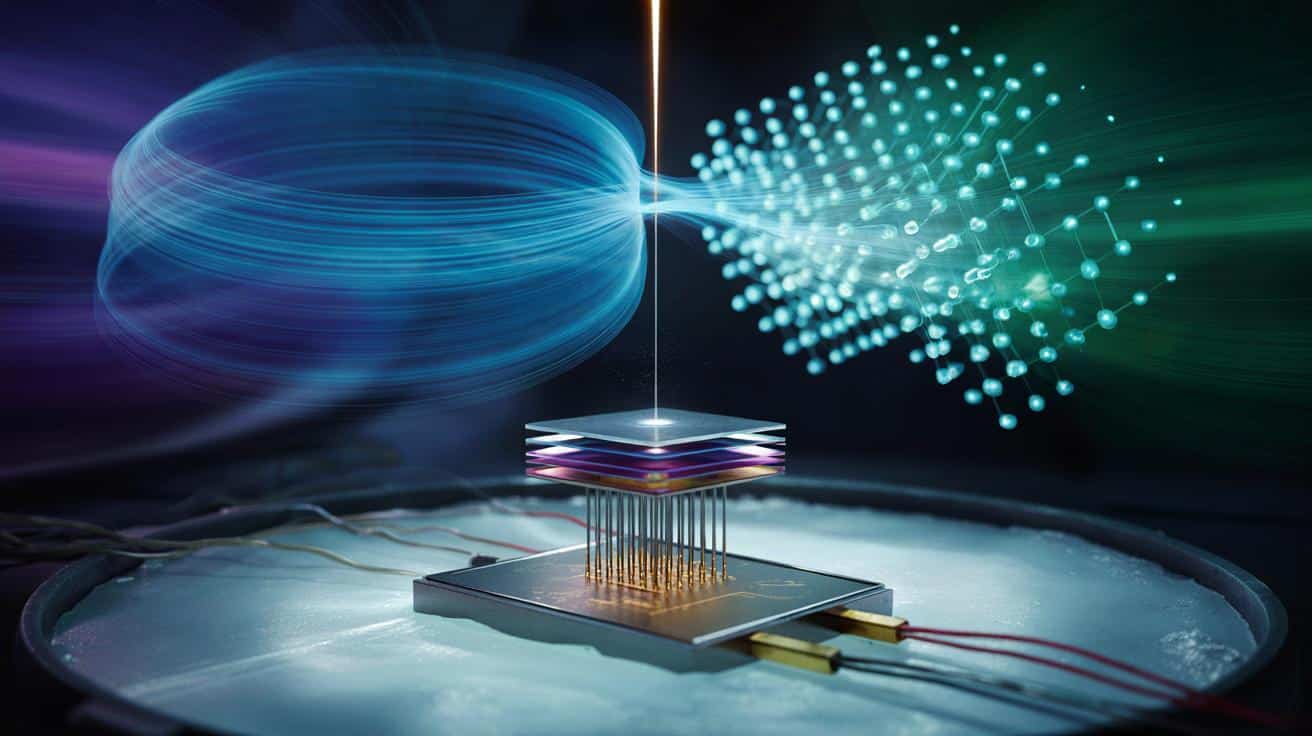
To spot these excitons changing phase, the team stacked two sheets of graphene, each just one atom thick. Graphene is often described as a single layer peeled from graphite, the stuff of pencil lead, but in the quantum lab it becomes a playground for exotic physics.
The researchers positioned the two layers of graphene extremely close to one another, then applied a strong magnetic field and chilled the device to temperatures barely a few degrees above absolute zero. Under these harsh conditions, electrons in one sheet and holes in the other started to pair up across the gap, forming a dense “soup” of excitons that moved together.
By tuning temperature alone, the same exciton fluid first flowed without friction, then froze into an ordered state, and then melted back again.
From frictionless flow to crystalline order
Between roughly 1.5 and 4 degrees Celsius above absolute zero (about 2.7 to 7.2 degrees Fahrenheit), the excitons entered a superfluid state. In a superfluid, particles flow collectively without resistance. Push the fluid, and it glides endlessly; stir it, and it forms tiny, quantized whirlpools known as quantum vortices.
This behaviour has been seen before in liquid helium and in ultracold atomic gases, but reaching it with excitons in a graphene-based device gives researchers tighter control and cleaner signals than in many earlier experiments.
As the temperature dropped further, something even stranger happened. The superfluid suddenly gave way to an electrically insulating phase. Current no longer flowed, indicating that the excitons were no longer moving freely.
The team argues that this insulating state is best explained as a supersolid: a phase of matter where particles settle into a crystal-like pattern while still, in principle, retaining superfluid properties.
➡️ Kanzi the bonobo could play pretend — a trait thought unique to humans
➡️ AIChina, Russia condemn Trump’s pressure on Venezuela
➡️ What are the unexpected health benefits of walnuts?
➡️ Grim photo captures polar bear mom and cubs resting in mud in summer heat
The low-temperature “insulating” phase appears to behave like a quantum crystal of excitons, pointing strongly to a long-sought supersolid state.
What sets a supersolid apart?
Everyday solids like ice or metal have atoms locked into a fixed lattice. Liquids have atoms that shuffle around freely. Superfluids are more radical: their particles merge into a collective quantum state, erasing friction.
A supersolid threads the needle between these categories. The particles arrange themselves in a repeating pattern, like a crystal, yet the system still supports frictionless flow and quantum vortices. The same material shows two seemingly opposite traits at once: rigid order and effortless motion.
- Solid: ordered structure, no frictionless flow
- Liquid: disordered, normal viscous flow
- Superfluid: disordered, frictionless flow
- Supersolid: ordered structure plus frictionless flow
For decades, theorists suspected that supersolids might emerge under extreme conditions, especially in helium and in ultracold atomic gases. Experimental hints have surfaced in several systems, including magnetic atoms arranged in optical traps. Those set‑ups, though, usually require intricate external fields and carefully sculpted interactions to force matter into the right pattern.
The new graphene-based experiment stands out because the transition seems to occur “naturally” once the temperature is lowered, more like water freezing into ice than a carefully engineered lab trick.
Shifting a long-held assumption about low temperatures
One of the most striking aspects of the work is that the superfluid does not represent the ultimate low‑temperature phase. In many systems, superfluidity is taken as the ground state — the most ordered and lowest-energy configuration available.
Here, the superfluid sits at slightly higher temperature. Cooling further drives the excitons into a different, more rigid arrangement that blocks electrical conduction. That unexpected sequence strongly hints that the “insulating” state is actually a solid of excitons, only possible in the quantum regime.
Seeing an insulating phase appear beneath a superfluid challenges the usual hierarchy of quantum states at ultralow temperatures.
To make that case stronger, the researchers measured how the system’s resistance changed with temperature and magnetic field. The patterns match theoretical predictions for a transition between a superfluid exciton condensate and a more ordered exciton solid.
Peering into a new quantum phase diagram
Physicists like to map materials on “phase diagrams”: plots showing which phase appears at which temperature, pressure or field strength. Water’s diagram shows the familiar regions of ice, liquid and vapour. For bilayer graphene filled with excitons, the picture is just emerging.
In this case, temperature and magnetic field act as knobs. By twisting those knobs, the team watched the system jump between normal insulating behaviour, superfluid conduction and the suspected supersolid phase. Each region leaves a distinct fingerprint in electrical measurements.
The phrase “pushing quantum boundaries” fits quite literally here. With each small change in temperature or field, the boundary between phases shifts, letting researchers map out where superfluidity appears and where the ordered insulating state wins.
Why this quantum trick matters outside the lab
At first glance, an exotic phase appearing just above absolute zero might sound too fragile for any practical use. Yet these experiments feed into a growing effort to harness quantum phases of matter for technology.
Control over superfluid and supersolid behaviour could one day lead to ultra‑efficient electronic components, precision sensors or novel ways to store information. Because excitons are tied to both electrical charge and light, exciton-based devices might bridge traditional electronics with optoelectronics and future quantum networks.
| Quantum feature | Potential use |
|---|---|
| Frictionless flow | Low‑power interconnects and ultra‑sensitive detectors |
| Ordered lattice | Stable, tunable patterns for data storage or signal processing |
| Temperature-tunable phases | Switchable quantum components acting as “on/off” elements |
There is also a more basic motivation: each new quantum phase adds a laboratory for testing theories of how many particles behave collectively. Supersolids sit at the intersection of condensed‑matter physics, quantum information and materials science, providing a rare chance to check calculations that are usually limited to computer simulations.
Key concepts worth unpacking
Two ideas tend to cause the most confusion in this story: absolute zero and excitons.
Absolute zero is defined as −273.15 degrees Celsius (−459.67 degrees Fahrenheit). At this temperature, a system has as little thermal energy as the laws of physics permit. Experiments never quite reach it, but they can come extremely close, as in this study. A few degrees above absolute zero is unimaginably colder than deep space, which sits at about 3 Kelvin.
Excitons are not particles in the same sense as electrons or photons. They are “quasiparticles,” useful packages that arise when many electrons interact with each other and with a crystal lattice. An electron jumps to a higher energy level, leaving behind a positively charged hole. The electron and hole attract, orbit each other and move through the material as a bound pair, acting like a single object.
Because excitons carry both charge and an imprint of the material’s structure, their collective phases — like superfluids and supersolids — are highly sensitive to external fields and temperature. That sensitivity makes them both challenging and promising for device applications.
What comes next for exciton supersolids
For now, the evidence for a supersolid phase in bilayer graphene is strong but not final. The team is designing new probes that can look more directly at how excitons arrange themselves, perhaps using advanced imaging or interference techniques to spot the underlying crystal pattern and any quantum vortices.
Researchers also want to push this physics to higher temperatures. Right now, everything happens just a few degrees above absolute zero, which demands complex cooling machinery. Different materials, or carefully adjusted stacking angles between graphene layers, might nudge the same effects closer to temperatures reachable in more conventional labs — and eventually, although this is still speculative, in engineered devices.
Beyond that, theorists are already sketching out scenarios in which multiple exotic phases might coexist or compete in similar systems: stripes of supersolid behaviour next to patches of ordinary insulator, or domains that switch between superfluid and supersolid under tiny electrical nudges. Each scenario could reveal new ways that quantum matter self‑organises when pushed to extremes.
For now, the core result stands: by working with some of the thinnest materials known and cooling them almost as far as nature allows, physicists have persuaded a quantum fluid to form its own crystal and then let it melt again — a reversible shape‑shift that edges quantum matter closer to something engineers might one day control on demand.