The alert didn’t arrive with sirens or breaking news banners. It crept into secure inboxes in Washington as a short, clinical briefing: “New Chinese deep-sea vessel equipped with large-scale cable-cutting system observed.”
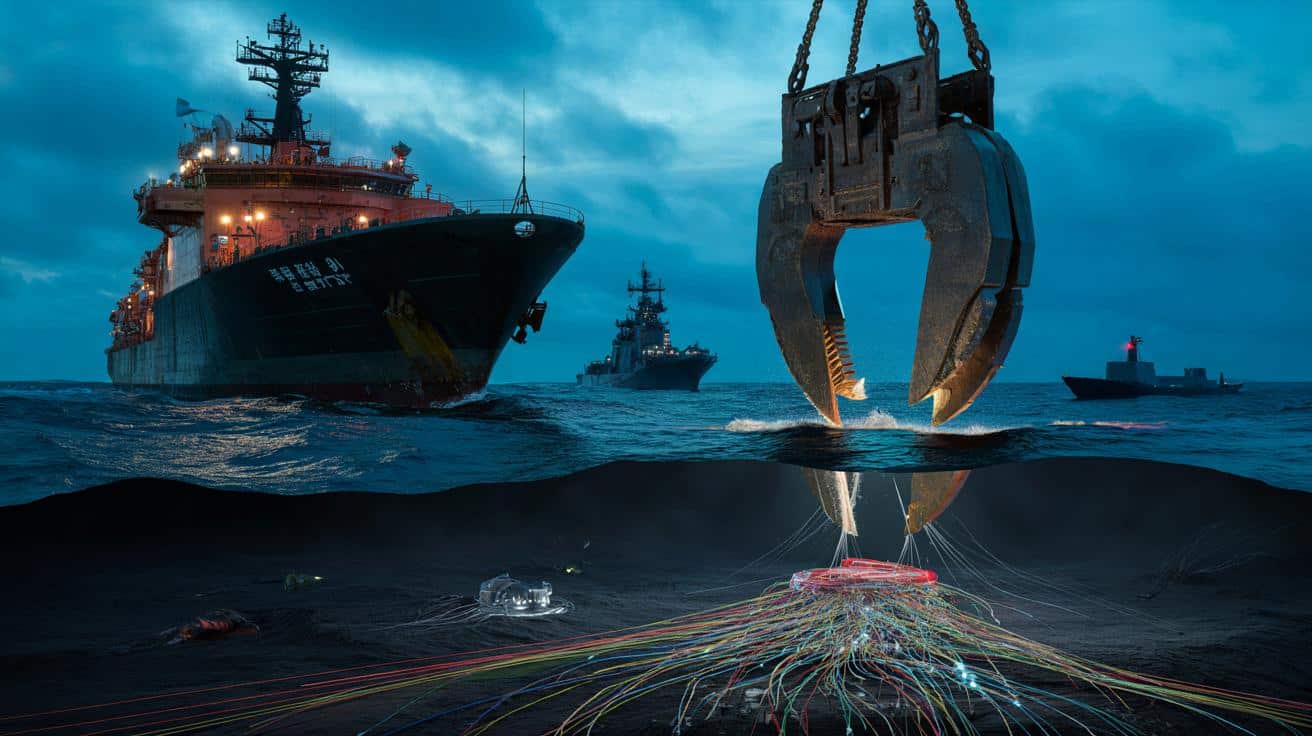
Somewhere in the Pacific darkness, a ship bristling with winches, cranes, and a jaw-like steel frame was lowering its tools toward the seabed — where the world’s real internet lives.
While we scroll, watch Netflix, and rage on social media, the lifelines that make all this possible lie silent on the ocean floor, barely protected, barely noticed.
Now those lifelines are being stalked.
Steel jaws in the deep: why Washington suddenly cares about the seabed
Picture a black hull cutting across a grey horizon, no tourists on deck, just cold metal and antennae. On its aft deck, a massive U-shaped frame hangs from thick cables, a kind of industrial guillotine built not for trees or steel beams, but for glass-thin strands that carry most of the world’s information.
That’s how several U.S. officials privately describe China’s newest “cable operations” vessels — ships that can lay, tap, or sever undersea internet lines with frightening precision.
In Pentagon briefings, they call them “dual-use platforms.” In plainer English, they’re **giant scissors aimed at the global nervous system**.
To understand the stakes, look at what happened in February 2023 around Taiwan. In less than a week, two of the island’s undersea cables were mysteriously severed, cutting off a remote archipelago’s phone and internet access for thousands of residents.
Formally, the incidents were “accidents,” attributed to passing fishing boats and anchors. Locally, people described it as being suddenly shoved back into the 1980s: card payments stalled, businesses froze, and even basic calls turned into logistical puzzles.
Now scale that up to the global level, where roughly 95% of the world’s international data traffic — banking, stock trades, military messages, dating app swipes — flows through a spiderweb of fiber-optic cables barely thicker than a garden hose.
You don’t need a war to cause chaos. Just a few well-placed cuts.
American analysts have been gaming this scenario for years, but the arrival of **China’s colossal cable cutter** — a catch-all term they use for advanced deep-sea assets — has pushed those tabletop exercises closer to reality.
Undersea cables sit mostly unguarded on the seabed, often mapped in public charts. They cross strategic choke points: the South China Sea, the Luzon Strait, the North Atlantic. Many have no redundancy. Slice two or three at the right spot, and an entire region’s traffic has to detour, slowing to a crawl or going dark.
We’ve all been there, that moment when a home router dies and the room fills with restless, panicked silence. Now imagine that feeling, not in a living room, but across a continent. The U.S. knows that in a crisis over Taiwan or the South China Sea, those steel jaws in the deep could suddenly “accidentally” bite.
What the US is quietly doing while the cables hum under our feet
Inside windowless rooms at U.S. Cyber Command in Maryland, maps of the internet look nothing like your browser. They’re tangled blue and red cords arcing across oceans, with blinking nodes where cables surface in Florida, California, Guam, Japan, Europe.
The first practical step the U.S. is taking is painfully simple: find the weak spots. Analysts are building detailed “cable vulnerability maps,” layering satellite data, ship movements, and classified intel to see where Chinese vessels have loitered near junctions or landing stations.
➡️ Shoppers in China rush to Ikea after furniture giant announces closure of 7 stores from Feb 2
➡️ This melting parsnip–potato gratin even reconciles kids with winter vegetables
➡️ This milk-braised pork roast is so tender you can cut it with a spoon
➡️ Italian torta nua: the recipe for this cloud cake with custard, a pure delight to share
➡️ Grim photo captures polar bear mom and cubs resting in mud in summer heat
➡️ Kanzi the bonobo could play pretend — a trait thought unique to humans
➡️ Italians Can’t Believe It: In France, Almost Everyone Cooks Pasta The Wrong Way
One senior official described it as “marking the Achilles’ heels of the global network” — not just to protect them, but, bluntly, to know where to hit back.
Beyond the screens and secure briefings, there’s a more physical response unfolding at sea. U.S. Navy submarines and surveillance aircraft have been increasingly routed along major cable corridors, from the North Atlantic to the Philippine Sea.
On the surface, some of these patrols look routine: a P-8 Poseidon flying a familiar loop, a destroyer passing near a cable landing site. Look closer, and you see the pattern: presence where cables meet contested waters, especially wherever Chinese “research” vessels have recently surveyed the seabed.
Let’s be honest: nobody really tracks their own information lifeline every single day. The U.S. is betting that China is counting on that complacency — that the world will only notice the cables once they’re gone.
At the policy level, Washington is trying to turn a sleepy technical topic into a frontline security issue. There are quiet pushes in NATO and the G7 to treat undersea cables like critical infrastructure on par with oil pipelines and satellites.
That means funding for redundancy — more routes, more landing points — and also legal tools. If a suspicious “accident” hits cables near Taiwan, Estonia, or undersea links to Guam, allies want pre-agreed responses, not frantic improvisation.
There’s another, less talked-about layer: espionage. The same gear that can cut a cable can also tap it. U.S. planners know this game well; they’ve played it since the Cold War. *Now they fear they’re no longer the only ones with the best toys on the seafloor.*
How this invisible war touches your daily life (and what actually helps)
So what does any of this mean when you’re just trying to send an email or move money abroad without thinking about seabed warfare? It starts with a mental shift.
When you hear about “network outages,” “routing issues,” or “latency spikes” in the coming years, especially during tense moments with China, don’t just think of a busy Netflix night. Think cables, think geography, think intention.
On a practical level, the most effective personal move is boring: build redundancy into your own digital habits. Two bank accounts, two messaging apps, offline backups for your key documents. One cloud, one hard drive. If a region’s traffic gets rerouted through a slower or censored path, you’ll feel it less if your life isn’t tied to a single fragile channel.
There’s a small, very human trap here: when threats become too abstract, we numb out. “Undersea cable sabotage” sounds like something from a Tom Clancy paperback, not Tuesday at the office.
That’s why so many people shrug off digital fragility until their payment app freezes or their remote job collapses for a day. The U.S. government is wrestling with the same problem at scale — knowing there’s a slow-moving storm and struggling to communicate it without sounding paranoid or technical.
If you work in a business that depends on flawless cross-border data — trading, logistics, cloud services — treating this as a real operational risk isn’t neurotic, it’s sane. Think backup routes. Alternative providers. Clear client communication plans if things slow or stall.
There’s also a cultural reflex we rarely name: we still think of “the internet” as wireless, floating in the air. The emotional reset the moment you realize it’s actually glass threads on the ocean floor changes how you read world news.
You start to see Chinese “research” trips near key straits differently. You notice when a cable near Yemen or the Red Sea suddenly fails. These aren’t random glitches; they’re pressure points in motion.
“Cables are the quiet front line,” a former U.S. naval officer told me. “Satellites get the Hollywood treatment, but the real war for information will be fought in the dark, 5,000 meters down.”
- Map your own digital dependencies: where your data lives, who carries it, what happens if that path slows or snaps.
- Spread your risk: use multiple services for storage, communication, and payments, not just one ecosystem.
- Plan for temporary disconnection: keep critical info and contacts accessible offline.
- Watch geopolitical hotspots: cable failures near tense regions are rarely just bad luck.
- Ask your providers about redundancy: pressure on companies nudges governments to act faster.
Living with fragile lifelines in a sharper world
Once you see the map of undersea cables, it doesn’t leave you. Thin lines racing out of New York and Virginia, fanning across the Atlantic. Thick bundles threading through the South China Sea, hugging the coasts of Japan, the Philippines, Taiwan.
Then you overlay the news: warships here, “fishing fleets” there, new Chinese seabed surveys over that junction where half of East Asia’s traffic passes. Suddenly, the internet feels less like a cloud and more like a crowded, contested shipping lane.
This isn’t a story about some distant military chessboard. It’s about how fragile our ordinary routines really are — the morning wire transfer, the afternoon video call, the late-night doomscroll — and how easily “steel jaws” in the deep could snap those threads. The U.S. is on high alert not just because Beijing might want that leverage, but because today’s world has quietly handed it over.
The next time your connection wobbles or a streaming service crashes, your first suspect will still be the Wi‑Fi box in the hallway. Fair enough. But somewhere behind that annoyance is a vast, physical network that can be disrupted on purpose, by design.
If anything, this strange new era is an invitation: to ask naïve questions, to push companies and governments for honest answers, to keep one eye on the busy surface of our screens and the other on the silent, crowded floor of the sea.
| Key point | Detail | Value for the reader |
|---|---|---|
| Undersea cables carry 95% of global data | Most international traffic, from payments to video calls, runs through seabed fiber, not satellites | Helps you grasp why cable sabotage or damage can hit your daily life fast |
| China’s “colossal cable cutter” capability | Advanced vessels can locate, tap, or cut cables in strategic areas like the South China Sea | Clarifies how geopolitical tensions can translate into real digital outages |
| Practical redundancy in personal and business life | Multiple banks, platforms, and backup plans blunt the impact of regional disruptions | Gives you concrete steps instead of just fear or abstract concern |
FAQ:
- Question 1Are undersea cables really that easy to cut or sabotage?
- Answer 1Physically accessing them is challenging, but for states with specialized ships and deep-sea gear, it’s very doable. The cables are mapped, relatively unprotected, and once a vessel is on site, damaging them doesn’t take science fiction technology.
- Question 2Could a single attack take down the entire internet?
- Answer 2No. The network is built with a lot of redundancy, especially on major transatlantic and transpacific routes. The danger lies in targeted cuts in chokepoints or regions with few alternative paths, where outages and severe slowdowns become very real.
- Question 3Why focus so much on China and not other countries?
- Answer 3Russia, the U.S., and others also have seabed capabilities, but China’s rapid naval expansion, its focus on the Western Pacific, and its “civilian” research and cable vessels near key routes have raised specific alarms in Washington.
- Question 4What is the U.S. actually doing to protect these cables?
- Answer 4Washington is increasing surveillance along key routes, urging allies to build more redundant cables, hardening landing stations, and pushing to treat cables as strategic infrastructure within NATO and other alliances.
- Question 5Is there anything ordinary users can realistically do?
- Answer 5You can’t patrol the seabed, but you can spread your digital risk: multiple services, offline backups, clear contingency plans if your main tools go down. And you can pay attention — the more public pressure on resilience, the harder it is for governments and companies to ignore these fragile lifelines.